The show
Muay Thai on deck
What the Muay Thai demonstration on the cruise is and isn't: the art of eight limbs, the wai khru ram muay ritual, its link to Hanuman, and why a deck is no place for a real bout.
Book a seat on the river ↗Quick answer
The Muay Thai on board is a demonstration, not a fight. Performers show the ritual and the techniques of Thailand's ring sport, whose nickname, the art of eight limbs, counts fists, elbows, knees and shins. Look out for the wai khru ram muay, the ritual dance fighters perform before a bout to honour their teachers, whose movements tradition traces to Hanuman, the monkey hero of the Ramakien. Want a real bout? Go to a stadium on another night.
A demonstration, plainly
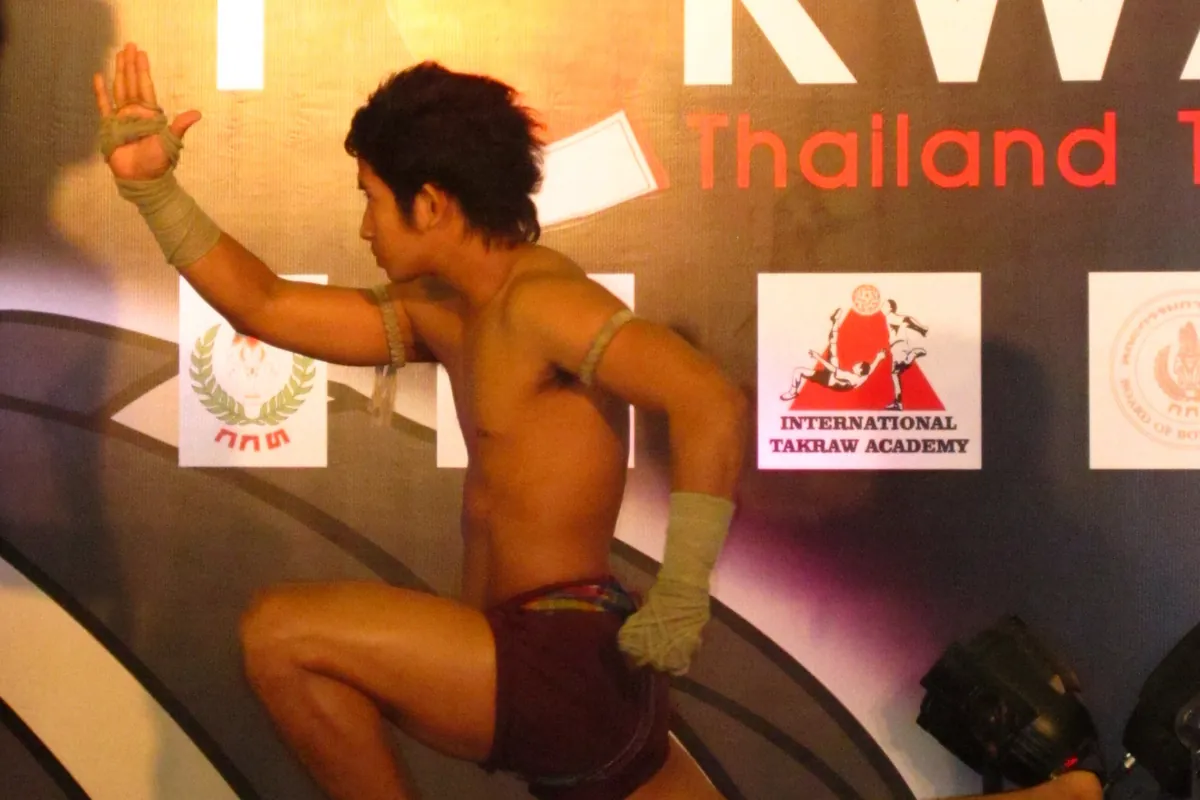
Nobody is knocked down on a dinner cruise. The Muay Thai act is a staged demonstration: performers show the moves, the rhythm and the ritual of the sport in a space that would never hold a real contest. That makes it suitable for children and for anyone who would not watch a fight, and it means the scoring, the rounds and the betting you would see at a stadium play no part. Watch it as a performance of a martial tradition, which is what it is.
Fists, elbows, knees, shins
Muay Thai is Thailand's full-contact ring sport, fought standing up with strikes, sweeps and clinches. The eight limbs of its nickname are the fists, the elbows, the knees and the shins, each used in pairs. It spread around the world in the late 20th and early 21st centuries, as fighters from Thailand began competing abroad. A professional fighter is called a nak muay. In a demonstration, the strikes are shown slowly or pulled, so you can follow techniques that would be a blur in a real round.
The ritual before the fight
Before a bout, fighters perform the wai khru ram muay. The wai is the Thai gesture of greeting with the palms together, and khru is the word for teacher, so the ritual thanks whoever trained the fighter. Fighters circle the ring and bow at the corners, then perform the ram muay, a sequence that can be very simple or very elaborate and often hints at where and by whom the fighter was trained. Music accompanies the movements. On deck, this ritual is often the most graceful part of the act.
Where Muay Thai meets khon
Tradition traces the movements of the ram muay to Hanuman, the monkey warrior who is the best-known monkey character in khon. The idea of wai khru also runs through Thai performance well beyond boxing, from classical music to khon itself, which is why a boxer and a masked dancer can share a stage without seeming out of place. Watch the two acts on the cruise with that thread in mind, and the evening's mixture makes more sense.
If you want to see a real bout
A demonstration shows the shape of the sport, not its intensity. If it leaves you curious, Bangkok has dedicated boxing stadiums where real bouts come with the full ritual, live music and the noise of a crowd. Book that as its own night; it does not fit around a dinner cruise. For many visitors, the deck version is enough to understand why the sport means so much in Thailand.
Watching with children
The demonstration is pitched for a family audience. Children often love the ritual dance and the slowed-down kicks, and there is no injury, blood or result to explain. Sit where they can see the performance space clearly, and let them ask about the armbands and the headband. Child rates exist on the cruise and the youngest travel free, which makes this one of the easier ways to show young travellers a piece of Thai sporting culture.
Sources